Listen to the presentation
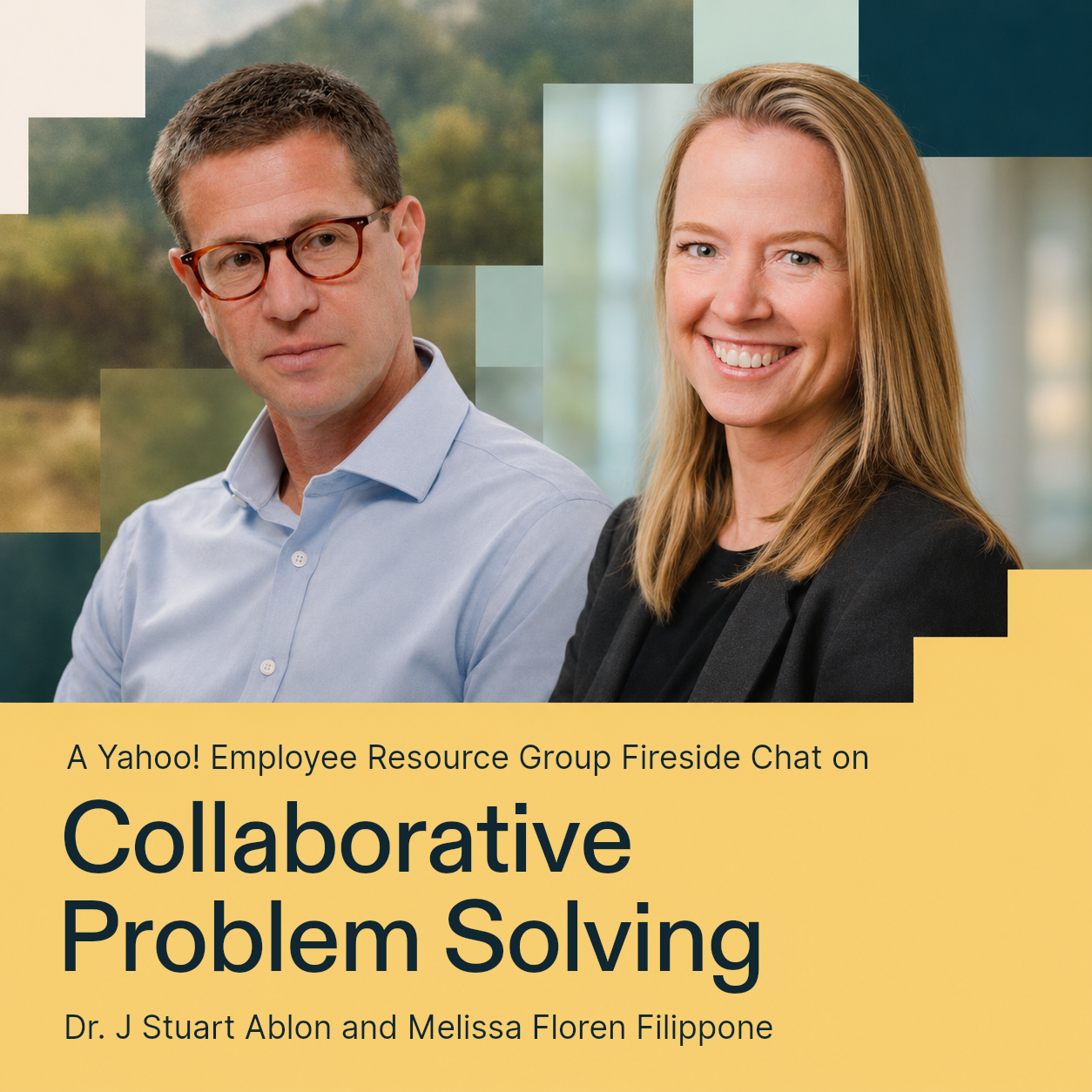
In a Yahoo! Employee Resource Group fireside chat, Melissa Floren Filippone and Dr. J. Stuart Ablon discuss how parents and educators can use Collaborative Problem Solving to work through conflicts with neurodivergent young people at home and at school.
Transcript
Tiffany Mayberry, Yahoo! moderator · Melissa Floren Filippone, Jake Collective CEO · Dr. J. Stuart Ablon, Think:Kids founder and director
Lightly edited for readability. Transcript picks up with Melissa minute 3:24.
Why Jake Collective exists
Melissa Floren Filippone · 03:24
Yeah. So I can start us off with why this work is so important to me and why Jake Collective exists. My husband has ADHD. I am a proud mother of children with ADHD, one of whom has super complex ADHD, so lots of other overlapping forms of neurodivergence also. And I’m also the CEO of Jake Collective.
We are a nonprofit, as Tiffany said, focused on supporting neurodivergent young people. We were founded on behalf of a young man who I’ve known and loved since he was born, named Jake Schreiber. His mom, Lori, is on this call. Jake had ADHD. He grew up knowing there was something different about him, something different about how his brain worked. He wondered about that often. He worried about that often. And most of the time with Jake, his differences made him truly exceptional. He was an aspiring physicist with a passion for astronomy, a musician, even an athlete. He was deeply loving and loved, and just an extraordinary kid. Jake died by suicide when he was 19 years old.
What we found when this catastrophe, this horrific loss, happened to the Schreibers and to all of us who love Jakey, we saw that there was this gap way beyond grief, way beyond even Jake himself. We uncovered an extravagant need and gaps in understanding and suffering that we didn’t know about that’s kind of hidden in plain sight.
So Jake Collective exists to fill some of those gaps. One in three young people under 30 in America self-identify as neurodivergent. Yet if you look at funding to understand neurodivergence, particularly ADHD and autism, the NIH, which is the largest source of biomedical research funding in the world, it’s 0.1%—one point—0.2%. Their categorical fiscal year 2025 funding data shows that 0.2% of their budget goes to understanding our kids.
And this gap shows in care. It shows in supports that are available. It shows up in basic understanding of the biology of some of these different neurotypes. What is emerging for ADHD in particular is a picture that is much more complicated than attention or executive functioning. Handing in your homework on time and sitting still for Mrs. Smith in second grade is just a tiny little part of what’s actually going on for the human beings who live with ADHD. And we’re just in the early days of understanding the biology and the enormous variation of how neurodivergence shows up in people.
Dr. Ablon is one of the practitioners and researchers who is at the forefront of understanding what the lived experience is like. What we’re learning is that the complete way that a person perceives the world—ADHD, autism, touch, emotion and reward and sleep, sensory changes, really the whole body—social challenges and connections are different, how they’re made. And it’s a whole different way of moving through the world. Basically, the world doesn’t know yet how to properly create environments in which these young people that we serve can thrive.
So Jake Collective is funding some of the research gaps so that we can have some of this basic understanding. And we’re also at the same time working with schools to help understand environments that will be safer for our kids. And we are looking at tools for parents and caregivers that exist today. And this is where Dr. Ablon comes in. Dr. Ablon and his team today have parenting classes and classes for teachers and educators that can help us understand neurodivergent students and learners and children and more effectively parent them.
When I first met Dr. Ablon, I was holding back tears because his research and his classes and his tools were what I wish I had had 20 years ago. And I know my dear friend Lori felt the same, that these are tools that parents need. I remember feeling that when I would talk to other parents of neurotypical kids with neurotypical problems, which are not small either, the books that everyone else read don’t work. They did not work. I felt sometimes [wording unclear] if someone told me to read Love and Logic again. I was like, “It doesn’t work on my kid. I hate you for saying that.”
And so then I met Dr. Ablon, and here’s a course and training and skills and reframes of behavior that would have worked for my daughter. And I wish every teacher that my kid had had these tools at their disposal. So, Dr. Ablon, can you tell us about this innovation, Collaborative Problem Solving, and maybe even start by explaining what neurodivergence is to this group? I listed ASD [autism spectrum disorder] and ADHD, but maybe you could talk about the understanding more broadly.
Neurodivergence and the role of skills
Dr. J. Stuart Ablon · 09:23
Yes, sure. I’d be happy to. And I think you’ve done a wonderful job capturing many elements of it here already. But as folks are probably getting the sense, neurodivergence is a pretty wide umbrella term. And Melissa, you cited the data that a third of young people today identify that way. It’s really a broad term for when someone’s brain is wired in different ways than what we would consider neurotypical, which is interesting because there is no single neurotypical brain.
But in essence, when we’re referring to neurodivergence, we’re talking about people whose brains process information differently. And that can include how they think, how they focus, how they attend, how they communicate. And in terms of familiar diagnoses, it does encompass things like autism, attention-deficit/hyperactivity disorder, learning disorders, learning differences, and other neurodevelopmental differences. But it’s really broad.
And I think one of the things that we try to do with our work is to sort of zoom in a little bit more and to say that the best way to understand kids, particularly neurodivergent kids, is to look through the lens of skills and to really try to identify which skills are areas of relative strength for a young person and which skills are things that are a struggle for them. And if there’s one thing that’s true about neurodivergent youth, it’s that skills, sort of strengths and challenges, can develop very unevenly.
And so I think it’s really important out of the gates here to acknowledge that when we talk about neurodivergence, divergent does not mean deficient. Neurodivergent people have incredible skills, incredible strength. And sometimes, in fact, their strengths are also their biggest challenges or weaknesses. And we can get into what that looks like. But you often have these uneven profiles with incredible gifts to bring unbelievable things to the world. And then the underside of that is sometimes some struggles as well. But I think, Melissa, one of the things you’ve alluded to already is these kids have been horribly misunderstood for a long, long time. And it might be helpful for us to sort of jump into what those misunderstandings have looked like and what more accurate understandings look like.
Melissa Floren Filippone · 11:57
That would be great. Let’s go there. So what are some of the misunderstandings? And if you could also expand that into what it’s like to be in elementary school with these misunderstandings.
Dr. J. Stuart Ablon · 12:07
Yeah, well, when you are a kid, or anyone for that matter, who processes information differently, whose brain is wired a little bit differently, what it means is that sometimes you’ll have a hard time sort of meeting the regular expectations of the school day or the home day or the workday. And sometimes your behavior might present itself in ways that feel challenging to people.
And unfortunately, for too long, we sort of viewed those challenges through the lens of motivation or discipline or, even worse yet, frankly, character, and attribute all kinds of things. The most common thing, though, is that we’ve tended to assume that if somebody is struggling to meet expectations, it’s a lack of desire to do so, a lack of motivation or a lack of will. And one of the things I try to teach people is that we’ve learned a lot about behavior in the last 50 years, really. And what we know beyond the shadow of a doubt is when somebody’s struggling to meet expectations during the course of their day, it’s very unlikely that they lack the will to do so. What they tend to struggle with are some skills that are necessary to meet expectations. And again, these are the skills with neurodivergent youth that can be very uneven.
So let me give you an example. Cognitive flexibility is a fancy way of saying flexible thinking. It’s a skill that is demanded of us all day, right? I work with a lot of neurodivergent youth who struggle with cognitive flexibility, but it is an incredible gift and a challenge. And here’s what I mean by a gift. Some of the youth I’m talking about here, they can memorize and acquire information unbelievably quickly and powerfully. You tell them something once and it is burned into their brain and they will never forget it. So, incredible learners. However, if you ask them to take that information and flex it a little bit, adjust it to a different situation or something like that, that can be very hard. And so it’s a good example, I think, of where strength can also be a challenge.
But what we encourage people to realize is that behavior is about skill, not will. And our sort of foundational idea behind our work is that kids, and in fact, people do well if they can. Not “people do well if they want to.” Not “kids do well if they want to. If they’re not doing well, we gotta make them want to.” But kids do well if they can. Neurodivergent youth are trying harder than anybody else to fit into the world. And what we need to do is realize they’re working overtime, help them with the things that are a struggle for them, and celebrate and leverage their incredible strengths at the same time.
Emotion regulation and masking at school
Melissa Floren Filippone · 15:00
That’s beautifully said. I’m curious about your view on the emotional dysregulation piece that often comes with neurodivergence. Could you talk to us a little bit about that and why it’s so present in our kids?
Dr. J. Stuart Ablon · 15:12
Sure. Well, we talk about emotion regulation. Let me translate that because it’s a sort of jargon that’s thrown around a lot these days. And I always like to remind people the word “regulate” just means to manage or control. So what are we talking about? We’re talking about our ability to manage or control our emotions. And when we say emotions, it’s a broad category, right? It’s your ability to manage your response to frustration, sure, but to anger, to nervousness, to anxiety, to fear, to excitement, to enthusiasm.
We spend all day trying to regulate, manage, and control our emotions. And many neurodivergent youth have struggles doing that. Now, what that means is they can feel things incredibly intensely, which is, again, a gift, right? But the challenge is being able to manage or control those in environments where one needs to.
And Melissa, in our work, we tend to look through the lens of five different categories of what we call neurocognitive skills, brain-based skills. And one of those categories is emotion and self-regulation. It’s the ability to manage, control your emotions, but also the ability to control yourself, like impulse control and things like that.
Melissa Floren Filippone · 16:24
Yeah, absolutely. And so that’s a really great point because if you’re in school and you’re meant to act a certain way and that’s not how you’re built, you can see the friction. Where does masking and camouflaging fit into this whole picture?
Dr. J. Stuart Ablon · 16:38
Yeah, well, school’s a great example. I cannot tell you how many kids I have worked with over the last 30 years who work inordinately hard to control their emotions, their impulses, and to fit into the school day that might not be that well suited to them. And it is exhausting. That’s really what masking is. It’s really sort of trying to fit into societal expectations and sort of blunting constantly your natural responses.
And those kids finish the school day exhausted and often melt down a lot at home. And what’s interesting then is people often say, when they hear about kids struggling at home, “Well, they look great at school. So they must be doing something wrong at home.” And then comes the parent blaming that my field, psychology and psychiatry, has a long history of doing, when it’s all about fit of environment, first of all.
Kids spend most of their waking hours, from when they get to school till they get home, really trying to manage all these things, exerting so much effort to control themselves. They don’t have anything left at the end of the day. And I always like to remind us adults and everyone, whether you have the most neurotypical brain in the world, we all do this. We spend a lot of time in the world controlling our impulses until we get home. And then we don’t have a whole lot left, which is why we often behave our worst with the people closest to us in our home, unfortunately. This is just magnified exponentially for neurodivergent people.
How Collaborative Problem Solving works
Melissa Floren Filippone · 18:19
That makes a lot of sense. And it sounds like a setup, really, for our kids, a structural setup with school built the way it is. So, Collaborative Problem Solving. This is a tool that Jake Collective is going to bring to the world, bring into classrooms. Could you give us an overview about how it works and why it’s powerful?
Dr. J. Stuart Ablon · 18:44
Absolutely. And as I mentioned, it starts with a mindset. And the mindset is kids do well if they can, not kids do well if they want to. If my child is struggling, this is about skill, not will. And let me try to be mindful of which types of skills my child is struggling with. Are these language and communication skills? Are these attention, working memory skills, emotion regulation, self-regulation, flexible thinking, social thinking? A whole host of skills.
But then we really try to equip parents and others with some very practical tools. And you said earlier, Melissa, if you had to hear about Love and Logic one more time, right? And you said something really important. You said, “It doesn’t work on my kid,” right? “It never worked on my kid.” And this is one of the fundamental problems, I think, with the approaches that we teach. They are things that we use on kids. They are techniques that we apply to kids.
And if there’s one thing I’ve learned about working with kids in general, and specifically neurodivergent kids who think differently and have amazing insights and contributions, it’s that you can’t try to have something that works on them. You have to work with them. And that’s what Collaborative Problem Solving is all about. It’s about working with kids. It’s about realizing that attempts to impose your will upon kids, whether they’re nice or not nice, whether they’re harsh, whether they come with a good rationale or not, they are ineffective and often make matters worse.
Now, as for being hands-off and letting your child make the decisions on their own, there’s a place for that. And I think Tiffany referenced Mel Robbins’s The Let Them Theory. We talked some in there, in the work she and I did together, about the utility of letting them at times.
But there are times when you have concerns and you can’t just let them. And trying to make them is not going to work. Collaborative Problem Solving is saying, “Let’s work together here.” Whatever the expectation is the kid’s having a hard time meeting, the problem they’re having a hard time solving, let’s work together. And the fundamental starting place for working together is empathy. And people, I often say, misunderstand what we mean by empathy. Empathy is not sympathy. It’s not saying, “I can see something’s really hard for you.”
Empathy is understanding. Empathy is gathering information. Empathy is learning from your child. And you can do that by asking them a lot of questions, by reassuring them that you really want to hear what their experience is like, what their concerns are, their perspective, and listening really hard to get their perspective on the table. And only once you do that do we encourage people to then share the adult’s perspective or concern.
And I want to point out something really important here. You don’t share, in Collaborative Problem Solving, your solution to a problem, because then you’re heading right back to trying to use something on your kid. You share your concern, what you’re worried about, your perspective, your point of view, which is valid and important. And in Collaborative Problem Solving, we like to say you know you’re doing Collaborative Problem Solving when you have two sets of concerns on the table. You have the child’s perspective and you have yours. And then you’re poised to do problem solving together.
And the hardest part oftentimes for us adults, and I’m a parent of three myself, is to invite our children to problem solve with us, but to give them first crack at generating solutions. Solutions that address their concerns, their perspectives, but also ours as the parent or the teacher. And that’s when you get buy-in. You grant autonomy and you give a kid a chance to practice the very kinds of skills that many neurodivergent kids can struggle with.
So that’s it in a nutshell, Melissa. Obviously, it sounds easier said than done. It’s hard, but we’ve been able to teach it to parents and other adults all around the world. And last thing I’ll say for now is we started this approach working with some of the kids with the most challenging behavior. So we’re talking about really severely traumatized kids with some really significant challenges and really significant lags in skills in places like prisons and things like that.
And we were able to demonstrate the effectiveness of the approach in terms of building relationships, building skills, helping kids better meet expectations. So I always like to just point that out because it started as a parenting approach and it’s still a parenting approach at its heart, but we’ve shown it can work in the toughest of circumstances. So it can work in my home and hopefully can work in the homes of other folks who are joining us today.
Listening first and repairing after a difficult moment
Melissa Floren Filippone · 23:43
And the sequencing, when I took your class, what shocked me the most was the sequencing, how critical it is to start with understanding from your kid. And it doesn’t mean endorsing the behavior. I remember at one point you walked me through, or the video did, the online class, about even something like weed. You can get to their perspective on this piece without condoning using drugs. Can you just give us some more examples of how that works?
Dr. J. Stuart Ablon · 24:11
Well, I think you’re saying something really important, Melissa, which is empathy doesn’t mean agreeing. To hear your kid out, even if you patently disagree with what they say, if you have a completely different perspective, you can empathize with them because what empathy is, is understanding. You can listen really hard and understand where they’re coming from. And one of the interesting things I found is the better you are at that, the more chance you have of your kid then listening to your perspective or your point of view.
And it’s not just common sense. It actually reflects brain science, really. And you talked about the sequence. It’s a neurobiological sequence. You see, we humans, we have to feel understood and listened to to be regulated. And if we are regulated, we are then able to listen to somebody else’s point of view. And only if we are regulated and relating to somebody else can we then reason. And we use our prefrontal cortex to problem solve. It’s literally a biologic sequence of moving up the brain.
So you must start with the listening. And the mistake we all make as parents all the time is we lead with our concerns and our solutions. And all it does is dysregulate our kids. And for some of you, that might look like your kid escalating. For some, it might look like them shutting down. For others, it might look like them saying exactly what they think you want to hear so they can get the conversation over with as fast as possible. So what we tell people is the sequence is listen first, then you can tell them what your point of view is, then invite them.
And even, you talked about, look, if your kid is smoking a lot of marijuana and you have concerns about that, your job is first to listen hard to why they’re smoking marijuana. And parents, I would equip you with a couple of thoughts and statements that I use a lot in my work.
I’m fond of reminding kids I work with that I’m just trying to understand where they’re coming from and that I think they have a very important reason for whatever’s going on. And that’s what I’m interested in learning about. And so if it’s smoking a lot of weed, “I’m sure there’s a good reason you’re smoking a lot of weed.” And when they say, “I like it,” “I’m sure there’s a good reason you like it. And I want to understand what that’s all about.” And they’ll say, “So you can tell me to stop smoking it?”
And that’s where I’ll say, “No, no. I hope if I can really understand where you’re coming from, that I’ll have a chance to explain if I have any concerns, but I don’t even know yet until I hear you out. So fill me in. There’s got to be a reason you like it so much. I wanna understand.”
And I counsel parents, or anybody for that matter, in this first ingredient, we call it the empathy ingredient. I studied this, Melissa, for like five years. I tried to study when it goes well, what happens, and when it goes poorly, what happens. And what I found is that as parents, if we do this well, we’re really only doing four things. And this should be like your Bible here, parents, for trying to empathize.
You ask questions to try to get information. If your child says anything to you at all, you reflect back in your own words what you’ve heard from them and then go back to asking questions. So questions and guesses and reflective listening. And if at any point it goes off the rails, you reassure them you’re not trying to impose your will. You’re not trying to just make them do something, you’re trying to understand.
And last thing I’ll say about this for now is I find it in my personal life as well, not just with my kids, but with anybody. I can’t tell you how often when I lead with empathy, how often I am so relieved that I did that, because I learn information from the person that has me completely rethink what I was worried about in the first place. In other words, I enter the conversation feeling frustrated myself, jumping to conclusions about what’s going on. And when I listen really hard, I find myself, “Wow, gosh, I have so much more compassion for what’s going on.” But also, this opens up opportunities for what we could do about this together.
Melissa Floren Filippone · 28:21
Yeah. And also you’ve taught me, and the course has taught me, that there’s also an opportunity for repair when you get it wrong. We’re not all gonna be Dr. Ablon on day one. Whenever I try this, it’s a little bit robotic at first. I’m like, “Well, tell me more.”
Dr. J. Stuart Ablon · 28:39
Let me be clear. If my kids were listening to this, they’d tell you that I’m not what I teach sometimes. And why is that the case, by the way? Because dysregulation is contagious, okay? It literally is contagious. So if your kid is getting dysregulated, you’re gonna get dysregulated too. And when we adults get dysregulated, we reach for power and control and we try to regain our footing by trying to make our kids do what we want. And it never goes well.
So this is hard. It’s easier said than done on paper. But I’ll tell you this, even bad Collaborative Problem Solving is better than trying to use an approach on your kid. And I also tell parents, this is not a secret. If you’re gonna try this, be transparent with your kid. Be like, “Hey, I learned about this thing that I want to try, and I may not be very good at it. And here’s what it’s going to sound like. I wanna understand where you’re coming from, ’cause I think maybe I haven’t been doing a great job of that. I wanna work really hard at that. And then I hope maybe you’ll listen to what I have to say, although I’m not gonna make it a lecture. And then I hope we can put our heads together here and problem solve. And if I don’t stick to that, hold me to it, because that’s what I’m trying to do here.”
Melissa Floren Filippone · 29:56
Yeah. I’ll tell you it does backfire sometimes ’cause now my kids know the words and they’re like, “Well, aren’t you going straight to solution finding, Mom?”
Dr. J. Stuart Ablon · 30:03
Hey, I don’t think that’s backfiring, Melissa. I think that’s a great thing. Can I tell you, that just reminded me of something. My eldest, who’s 27 now, was pretty small, and I was losing my cool with him. You got a little kid, their behavior’s challenging, it’s tough, you lose your cool. I started losing my cool, and of course I have done a lot of Collaborative Problem Solving with my kid. And he looked at me and he said, “Dad.” I said, “What?” And he said, “Can we just work this out?”
It disarmed me immediately. I sort of almost crumbled. I regained my footing and was like, “Yeah, of course, this is what I teach. Come on. Yes, I think we can work this out.” And I was able to sort of get back to where I want to be, which is starting with listening. And to your point, we’re gonna not handle things well. It’s hard. But you always have a chance to go back again and to say, “Hey, you know when we were talking about your homework the other day and how I got so mad at you because you weren’t turning off the iPad or putting down the Rubik’s Cube and doing your homework? I wish I’d handled it a little bit differently. And I’m hoping we can talk about it now so I can have another try here because I don’t like how I handled that.”
Uneven skills and social challenges
Melissa Floren Filippone · 31:19
And it’s so beautiful too because one thing I’ve learned along the way raising neurodivergent children is the grace that’s required for myself. I see some of these other families with all neurotypical kids, and it does seem a lot easier, Dr. Ablon. It does seem like you can have fewer skills and be successful in terms of…
Dr. J. Stuart Ablon · 31:42
Absolutely. Well, if your kid has just a more even profile that helps them meet expectations, if they’re an easy kid, you know, the work I do in schools all the time, when I hear teachers say, “He’s such a great kid,” oftentimes I know what they mean by that is, “He’s an easy kid because my job is so hard, but he just goes along, goes with the flow.” Versus the kid who, instead of going with the flow, needs to know [wording unclear] at all times and has a hard time being flexible. That’s a kid who’s harder to work with. And so the world is a more challenging place when you have an uneven profile like that.
And the other thing I’ll say is when people see extraordinary skills, they often assume then that if you’re not handling something well, it must be just a lack of effort because you’ve got this extraordinary brain, right? Or, “I’ve seen him do it once before, but why isn’t he doing it now?” Even though the context has changed or the state his brain is in has changed at that point.
Melissa Floren Filippone · 32:45
And so that begs for more masking and more hiding because you’ve got that imposter syndrome. “I’m like this at math and I can’t hand in my homework. What is going on?” And so you hide.
Dr. J. Stuart Ablon · 32:57
Yeah, and it’s really disorienting for kids themselves. And you alluded to this with Jake, how hard it is to operate in the world where you feel exceptional at times and you’re like, “This stuff is easy and I’m really good at this and I get all this incredible feedback. And then, wait a second, why is this thing so hard for me?”
And kids start to buy the conventional wisdom themselves and they think, “I must not be trying hard enough in this instance because I’ve gotten all this feedback about how skilled I am in so many ways. In this area, I just must not be trying hard enough.” And that is such a dangerous thing for a kid to start feeling about themselves, especially when that’s not what’s going on. It’s explicitly the opposite of what’s going on.
Melissa Floren Filippone · 33:45
The opposite is true. And before we switch to teachers in the classroom and how we can advocate for our kids in the place where they spend most of their time that isn’t home, what about the social piece? I know you’ve worked with a lot of kids who have really struggled with ODD [oppositional defiant disorder] and other things in prison settings and residential treatment settings, but what about just in a typical elementary school setting? Why are the social challenges there and how can we support our kids with friendships and connections?
Dr. J. Stuart Ablon · 34:18
Yeah, well, if you think about all those areas of skill, I quickly reeled off like five areas of skill, I think, earlier, that are sort of required to manage your behavior and meet expectations. Social interactions require all of those skills simultaneously. All of them. And so if you struggle in any one of those skill domains, it can make social interactions very hard.
On the one hand, kids can be very empathic and understanding. On the other hand, they’re very impressionable and they buy into assumptions about other kids’ behaviors very quickly. So in the social arena, unfortunately, many neurodivergent youth start to feel very misunderstood, very sort of isolated, criticized, and ostracized socially.
Now, in schools, that’s the natural social milieu where we have the most opportunity to help kids navigate these kinds of situations. And that’s where there’s a different form of Collaborative Problem Solving that we use, which is basically Collaborative Problem Solving with a group of kids. You can do Collaborative Problem Solving with two kids, three kids, five kids, a whole class. And it’s one of the things we teach a lot of the schools we work with to do, is how to use this process with kids together and help them try to learn it so that they can do it independently with each other moving forward. And everybody wins when you do that.
Working with teachers and schools
Melissa Floren Filippone · 35:55
Well, that’s a natural segue to our work that we’re trying to do with teachers. And one of the things that Dr. Ablon has taught us is that you need to use the right words when you’re trying to train the trainers, the teachers, because if you say the wrong words, it’s like, “This is not a lesson for me.” And so that’s one of the things that we’re working on together, right, Dr. Ablon?
Dr. J. Stuart Ablon · 36:17
Sorry, if I could just add quickly, schools have a long history of using school discipline to respond to social-emotional challenges. And school discipline has been woefully inadequate. And frankly, it is sort of applied disproportionately to the kids for whom it does not work.
Because school discipline is all about rewards and consequences. It’s all about just trying to motivate more compliant behavior. And as I said at the outset, it misses the mark because these are kids who are trying harder than anybody else to navigate the day successfully, because it doesn’t come to them naturally in some ways.
So it’s a big lift to sort of rethink and shift school discipline, but it’s part of the work that I’m so excited that we’re partnering on together with the support of Jake Collective because you can transform school discipline and the outcomes as a result. And we’ve shown it. We study everything we do and the data are clear. So it’s just about getting this information and evidence-based practices into the hands of our educators, who, by the way, are trying the best they can. Teachers do well if they can. Teachers are under enormous stress right now, with very limited resources, trying the best they can, and we need to better support them.
Melissa Floren Filippone · 37:38
Right. They too have the skills—they don’t have the skills that are required. And that makes sense. While we’re out trying to transform school discipline and get these skills out there in the world, what can we do when your kid is stuck in a classroom with a shame-based teacher? The old-school “Why can’t you sit still?” [wording unclear]. And you go to parent-teacher conferences and you’re that mom with that kid. What can we do to advocate in those settings? And what can we do even preemptively, before school starts [wording unclear]?
Dr. J. Stuart Ablon · 38:15
Well, I’d like to say that the most effective thing would be education, which is like sharing resources and information with schools and educators. And that can be helpful, but the reason I’m hedging there is sadly, when a parent brings information to the school, it’s often not given full consideration, even though we parents, we know our kids better than anybody, right?
So my real recommendation is to use Collaborative Problem Solving with the teacher in question. And what that looks like is listen hard to their perspective, concern, what they think is going on with your child, even if you don’t agree with it. Bite your tongue, listen, reflect what you’ve heard, say, “Have I got you here? I want to make sure I’m understanding.” And then say to them, “Because here’s what I’m worried about. I’m concerned that my kid’s trying really hard to be able to sit still in class. It’s not something that comes easily, even though, as you’ve said, they’ve had these incredible skills. It’s really hard for them to access the curriculum. And I think it’s having a big effect on them. And I wonder if there’s something we could do together to try to address this. I know I have some resources that have been helpful at home.”
So in other words, you gotta be careful not to try to impose what we think are gonna be good solutions on the educator. You need to work with them.
Melissa Floren Filippone · 39:52
Okay. So there’s Collaborative Problem Solving again. You gotta do it everywhere. It’s exhausting and we can do this.
Dr. J. Stuart Ablon · 39:59
Well, it’s no more exhausting than using approaches that are poorly matched to the problem and make everything worse and make everybody, including your child, feel bad about themselves. Collaborative Problem Solving is not easy, but anytime you’re actually getting to the heart of the problem and building relationship as you do, things are gonna be easier in the end.
Audience questions and resources for families
Melissa Floren Filippone · 40:24
That is so, so true. And Tiffany, I know we wanted to leave time for Q&A. Is this a good time to open it up?
Tiffany Mayberry · 40:33
Absolutely. I think we should. So if anyone has any questions, please feel free to drop them in the chat. I know that we do have one question about how to buy a book for your children or otherwise share this information.
And also I would love to ask both of you, each of you, what’s one resource, whether it’s a book, an organization, a tool, that you would point to for the audience to think about as well?
Melissa Floren Filippone · 41:39
Well, I can do a plug for the course that we’re going to be launching together shortly. It already existed. We’re just repackaging it so that parents can have exactly the training that I described that I was lucky enough to do with Dr. Ablon and that every one of you can do directly. But Dr. Ablon, what would you put out there? I know some of these examples are already on the site.
Dr. J. Stuart Ablon · 42:01
Gonna take the liberty of giving more than one resource. But first of all, I would send people, for parents, right to our website. Our program’s Think:Kids. We can put the URL in there, but it’s thinkkids.org. And just click on the tab for parents, and there’s all kinds of resources. There’s self-paced courses you can take. There’s live courses with other parents that are done remotely for folks who wanna learn more about the approach.
But yes, you can learn it via books as well. I’d probably suggest the book Changeable, which is also available on audiobook if you’re somebody who prefers to listen to them. And look, I think podcasts are an incredible way these days to pass along information. And so if you’re a Mel Robbins person, great. Check out the podcast I did with her. If you’re more of a Hidden Brain person, check out the podcast I did on Hidden Brain. Those are good opportunities to do a deeper dive as well.
Melissa Floren Filippone · 42:59
You didn’t even plug your book that’s coming out shortly.
Dr. J. Stuart Ablon · 43:03
It could take a little while to come out. But yeah, Mel and I are doing a parenting book that will eventually come out. So hopefully that’ll be a really good resource for folks ultimately, too.
Melissa Floren Filippone · 43:14
I know it will. Tiffany, I saw a great question just pop up in the chat.
Talking about cannabis use
Tiffany Mayberry · 43:20
There’s a question about the point about weed. “These are things I feel like it’s better to stop before addiction and brain wiring changes. How do we collaboratively prevent these habits before they happen?”
Dr. J. Stuart Ablon · 43:40
Yeah. Well, yes. And my department of psychiatry here at Mass General Hospital, we’ve had a lot of research on the impact of consistent marijuana use on adolescent brain development. And the bottom line is it’s concerning, very concerning and scary. So we’re right to be worried. And what I would do is I think you do have to listen really hard to your kid and try to understand why they’re smoking so much. And follow what we said before, which is there’s probably a good reason. There is something it is helping them with, something it is working for, something it’s addressing. And you want to understand what that is.
And only once you try to get a sense of that can you then, I think, raise the concern, which is exactly what the question was, which is, “I’m worried about the impact on your brain and your mental health. And I am concerned that we know that there are some really negative impacts of consistent marijuana use.” And what I would do, by the way, in this conversation is as soon as you say something like that, your child’s gonna think, “Here we go again.”
Dr. J. Stuart Ablon · 44:53
And that’s where I would jump in with some reassurance right away and say, “This is not me saying, ‘So you have to stop. And if you don’t stop, here’s the consequence.’ What I’m saying is I’ve got concerns. And I’m hearing that there are important reasons you’re smoking so much. And I’m wondering”—here comes the third ingredient, the invitation—“I’m wondering if there’s something we can do to help address what you’re describing in a way that is going to be less concerning for its impact on your brain.”
And to give you an example, a very common conversation I’ve had with kids is that, in the words of one of the kids I worked with, he said, “I’m like jumping out of my skin all the time in class.” And it’s not hyperactivity per se, but it’s just this anxious, jumping-out-of-my-skin feeling that the only thing he’s found has settled it has been marijuana. And he’s like, “That’s how I can go to school.”
Okay, that’s reasonable. And that drug has some very negative impacts. Maybe there are other things we can do to help you with this feeling of jumping out of your skin without those negative impacts. And that’s where I would say, “And I don’t know what they are necessarily, but I wonder if we could explore those together and see what might be out there.”
When to step in about masking
Melissa Floren Filippone · 46:09
Yeah. And that’s a scary conversation and it’s a hard conversation and it’s the critical conversation. I really appreciate how you laid that out. There’s a really important question in the chat around masking. “When is it better to encourage neurodivergent kids to practice masking? And when is it better to try to intervene and get the school or other organization to stop forcing them to mask and have those battles?”
Dr. J. Stuart Ablon · 46:39
A good question. It’s such a balancing act because the reality is that some degree of masking is important, and as I mentioned earlier, all of us do it to some degree. We are constantly masking when it comes to impulse control. I like to joke with people, imagine if you said or did the first thing that came to your mind all throughout the course of the day, right?
Yeah, Tiffany, you’d laugh, right? It’d be funny. You’ll amuse yourself, but you’d be horrified, probably fired quickly, and all kinds of things like that, because we rely on our impulse control all the time. Even when it’s hard, we have to do that. And in many cases, we’re masking our impulses. That’s reasonable. It’s important to do.
But finding that line is really hard. Where is this too much? Where does this take too much of a toll on my child? Too exhausting, but also too invalidating to who they are, and they feel like they are not being their authentic self. And I think these Collaborative Problem Solving discussions give you a window into, “Is this hard, and I’m trying, and I know I gotta do it, but I don’t feel like I’m sort of sacrificing who I am? Or is this worse than that? And is this something where I’m barely getting through the day? I feel terrible about myself, and I can’t be myself.”
Those conversations will help you find, I think, that line, so you’ll know when to jump in. I would say this, though. I would overindex on the jumping in to support, because part of masking is kids have been taught in essence to keep this to themselves and to not be as forthright. And when you get reporting about how hard it is, it’s probably much harder than what is actually being reported.
Co-occurring conditions and thinking skills
Melissa Floren Filippone · 48:34
That is so a hundred percent true. We call “fine” the F word in our house, because it’s like, “Fine, I’m fine,” which means the opposite, right? And one of the things that Lori and I and the team have learned is just how early in our kids this feeling of burdensomeness shows up. And how infrequently something like ADHD or autism travels alone.
The stat that’s true is that with ADHD as an example, nearly 80% of ADHDers have another co-occurring condition. It almost never travels alone. And so these are unique challenges. These are more complicated challenges. And it’s exhausting. So the earlier we can learn about our kids’ unique challenges, the better.
I mean, what do you wish, Dr. Ablon, parents could know when their pediatrician says, “I think we’re looking at ADHD here. I think we might need to do an autism screening,” or these types of things, or dyslexia might be on the table? What do you wish parents would be equipped with then?
Dr. J. Stuart Ablon · 49:38
Well, a couple of things. First of all, I want all of us as parents to embrace the notion that every kid is working on something, not to mention every adult, right? We’re all good at some things and struggle with other things and we’ve all got things we’re working on. And I think that’s really important to communicate to your child because the world has endorsed that it’s okay to work on some things, but other things you sort of should already have down. And I think that’s a really important message to be constantly communicating to your child.
But when your pediatrician, your family doctor, raises the potential of sort of a diagnostic label, I want you to constantly be thinking, “Okay, but I want to get back to the level of skills.” And that doesn’t mean that a diagnosis might not be appropriate and could be helpful. But many times diagnoses for parents are a bit of dead-end explanations. Less so for the doctor, but what do I do as the parent? I don’t treat ADHD. But if I know my kid has a hard time shifting gears from one task or activity to another, that’s a skill. That’s something I can support them with and work on with them.
So whenever something is suggested that might be scary in the beginning, I want you to think through the lens of skills. And if you learn more about our work, we have an assessment instrument. It’s called our Thinking Skills Inventory. It literally is just a list of skills in those five categories. And as parents, you can look up and down those and you can start to spot and even talk with your kid about which parts are challenging and which parts are areas of strength. And that’s gonna be helpful to unpack potential diagnostic entities that might feel a bit more overwhelming.
When a conversation has not led to change
Melissa Floren Filippone · 51:33
That makes sense. Tiffany, what did we miss? Are there questions or are there other things that you’ve heard from the team that we should have covered? I see a hand up.
Tiffany Mayberry · 51:46
We have a question.
Audience member · 51:50
Dr. Ablon, I wanted to ask, I understand you addressed and brought up things like marijuana usage. What about scenarios where discussions are happening, you understand the perspective, but change is still not happening and it’s leading to criminal or civil liability for the parent?
Dr. J. Stuart Ablon
Yeah. Well, first of all, let me just acknowledge in a situation like that, it’s really hard to know how to be helpful without hearing a lot of specifics in terms of what’s going on for the individual child, because I’m gonna look through that lens of skills. And, for example, sometimes I will spot skill struggles that I don’t think are a great target of change for Collaborative Problem Solving and may need another intervention. And the sort of cleanest, clearest example of that is, while pills don’t teach skills, sometimes medicine is the most effective intervention for certain targets of change.
So, Collaborative Problem Solving is not going to solve everything, in other words. So I would need to know more about the profile, but then the other thing is I’d start troubleshooting the problem-solving process as well. Because oftentimes what looks like Collaborative Problem Solving can feel to a kid like it is just a fancy dressed-up version of us trying to make them do what we want them to do, which of course makes a lot of sense when there’s potential for incredible risk like you’re describing here, where you’re really worried.
And it’s one of the ironies, the more concerned we get as a parent, the higher the stakes are for our kids, the harder it is to stay in that collaborative place. But I would frankly need to hear a bunch more to really know how to be helpful. And I’m happy to figure out a way offline that we could do that if that would be helpful.
Closing takeaways
Tiffany Mayberry · 53:57
Thank you for that response, Dr. Ablon. And I want to be mindful of time because we have three minutes until we wrap. And so, in one sentence maybe from each of you, is there a quick takeaway that you would want everyone here to keep in mind as we close?
Melissa Floren Filippone · 54:20
Want me to go first, Dr. Ablon, since you’ve done a lot of lifting? I would just say that Jake Collective and other organizations are committed to creating the research and the solutions that our kids deserve that don’t exist today. And we are committed to bringing about that change in the world. So just know it’s gonna be a really exciting five to ten years for our kids. It really is.
Tiffany Mayberry · 54:46
Amazing. Thank you, Melissa.
Dr. J. Stuart Ablon · 54:48
And Melissa, I couldn’t agree more there because we’re understanding these kids accurately and compassionately now. And that leads us to a place where we can respond in a much more helpful, effective, collaborative way. And Tiffany, I would just sort of leave with the thought for us parents to lead with curiosity. Try really hard to be curious, not judgmental. Lead by listening, trying to gather information.
And most of all, remember that kids do well if they can. Your kid’s doing the best they can with the skills they have to manage what the world is throwing at them. And I know that’s true of all of us here as well. We’re doing the best we can with the skills we have to manage what our kids are throwing at us as well. And I really appreciate the opportunity to share some of our work and hopefully it’s helpful for folks.
Tiffany Mayberry · 55:39
I love this. This is such a powerful conversation. Thank you for taking the time to sit with us. We love the fact that you have been able to participate and share such great insights with us. So thank you for the time today. We are incredibly grateful. And we look forward to doing this again.
Dr. J. Stuart Ablon · 56:39
Thanks for having us.
Melissa Floren Filippone · 56:40
Such an honor to be with you. Thank you. Thanks, Tiffany.
Tiffany Mayberry · 56:44
Bye-bye.